






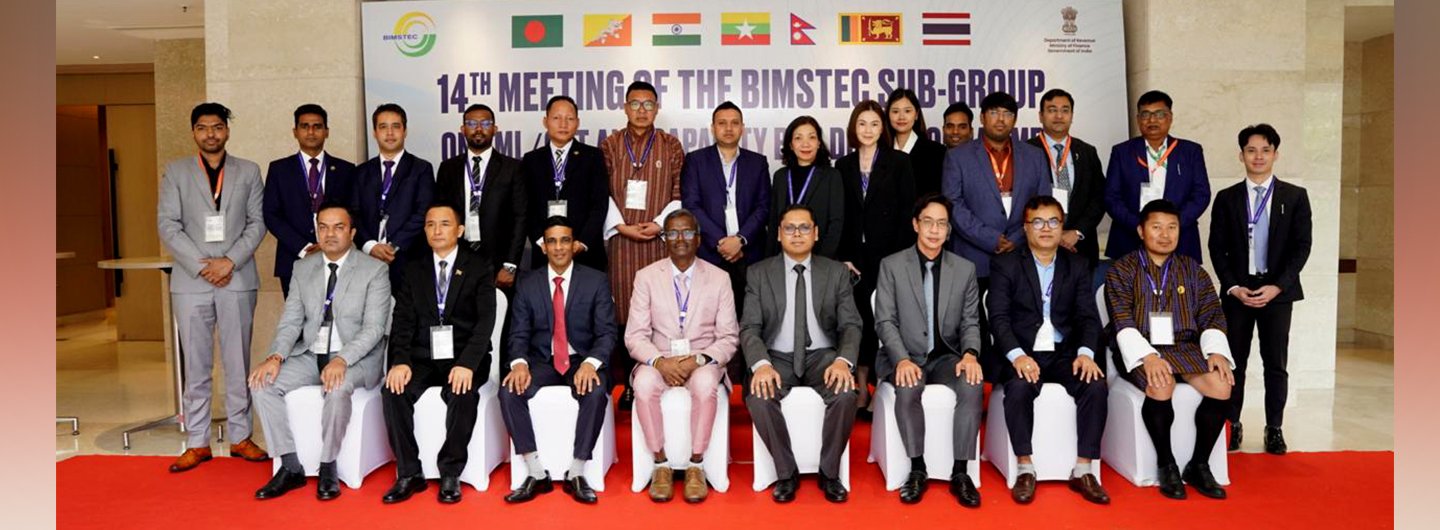
The Department of Revenue, Ministry of Finance, Government of India successfully hosted the 14th Meeting of the BIMSTEC Sub-Group on Anti-Money Laundering and Combating the Financing of Terrorism (SG-AML/CFT) in Shillong, India, on 20 July 2026. The Meeting brought together delegations from all seven BIMSTEC Member States, reaffirming their shared commitment to strengthening regional cooperation in combating money laundering, terrorist financing, proliferation financing and other evolving forms of financial crime.
The Meeting reviewed progress made since the 13th Meeting of the Sub-Group and exchanged views on national AML/CFT developments, emerging risks, evolving typologies and good practices. Recognising the increasingly transnational and technology-driven nature of financial crime, Member States underscored the importance of strengthening regional cooperation, timely information sharing, capacity building and the effective use of technology to enhance national and regional AML/CFT frameworks.
As a key outcome, the Meeting finalized the Paper on Illicit Flow of Funds (IFF) and the Action Plan to Prevent Illicit Financial Flows in the BIMSTEC Region, as well as the Memorandum of Understanding on Capacity Building for Combating Money Laundering and Financing of Terrorism, further strengthening the regional framework for cooperation, capacity building and collective action against financial crime. The Meeting also agreed to develop a BIMSTEC AML/CFT Work Plan (2026–2028) and emphasized the operationalization of the BIMSTEC AML/CFT Contact Point Network to deepen cooperation among Financial Intelligence Units.
The Meeting also discussed ways to effectively leverage BIMSTEC’s Observer Status in the Asia/Pacific Group on Money Laundering (APG) to enhance regional capacity building, facilitate knowledge sharing, and strengthen Member States ’preparedness for forthcoming FATF mutual evaluations.
Member States also held substantive discussions on emerging risks associated with virtual assets, fintech platforms, artificial intelligence, trade-based money laundering, online fraud and other cyber-enabled financial crimes. The Meeting underscored the need for stronger regulatory frameworks, enhanced public-private partnerships, improved analytical capabilities and closer regional and international cooperation to effectively address these evolving challenges.
Delegations expressed their appreciation to the Department of Revenue, Ministry of Finance, Government of India for the excellent arrangements and warm hospitality extended to all participants. The Meeting also conveyed its appreciation to the BIMSTEC Secretariat for its continued coordination and support.
***
 Share
Share
 Share
Share